B2B · WON HONORABLE MENTION
Extending collaborative learning beyond the classroom
Duration: 48 hours (March 2026)
Role: Product designer
Team: 4 designers
Skills: Rapid prototyping, User research, Collaboration
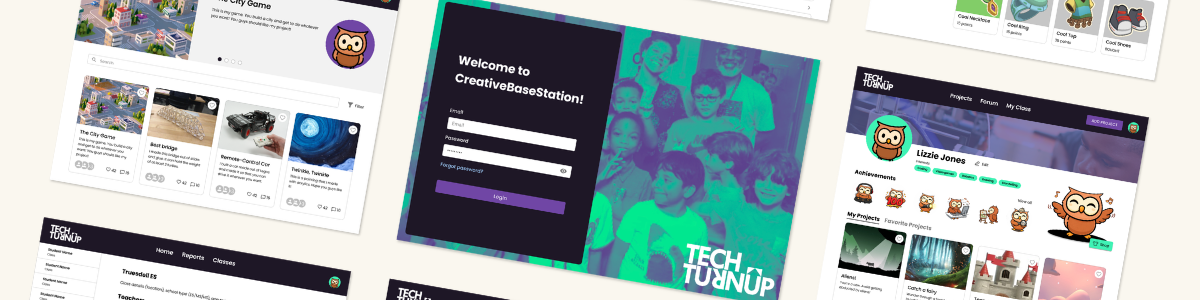
Within the span of a weekend, I helped design Creative Base Station (CBS), an online platform for Tech Turn Up (TTU) that allows students to receive academic help while also being able to share and collaborate on projects in a safe space outside the classroom. We had to quickly move from understanding the problem to developing and testing a viable product concept. Rather than TTU’s in-person programming online, we focused on designing a digital extension of its existing community.
DEFINING THE PROBLEM
Tech Turn Up empowers under-resourced youth through hands-on learning, but the benefits of these in-person programs are limited to program hours.
TTU is an afterschool program that empowers under-resourced youth in the DC area through creative technology and hands-on learning. TTU challenged us to consider, “how might we create a safe, engaging online space where young people can extend their learning and build together through small community circles and creative design quests?” One the first day of the challenge, we spoke with students ranging from elementary to high school, teachers, and staff to understand what they valued about the existing program and what they would need from an online space.
We synthesized our interviews using an affinity diagram, grouping recurring concerns, needs, and goals across participants. From these themes we identified several values that guided our design decisions: safety, collaboration, engagement/fun, and education.
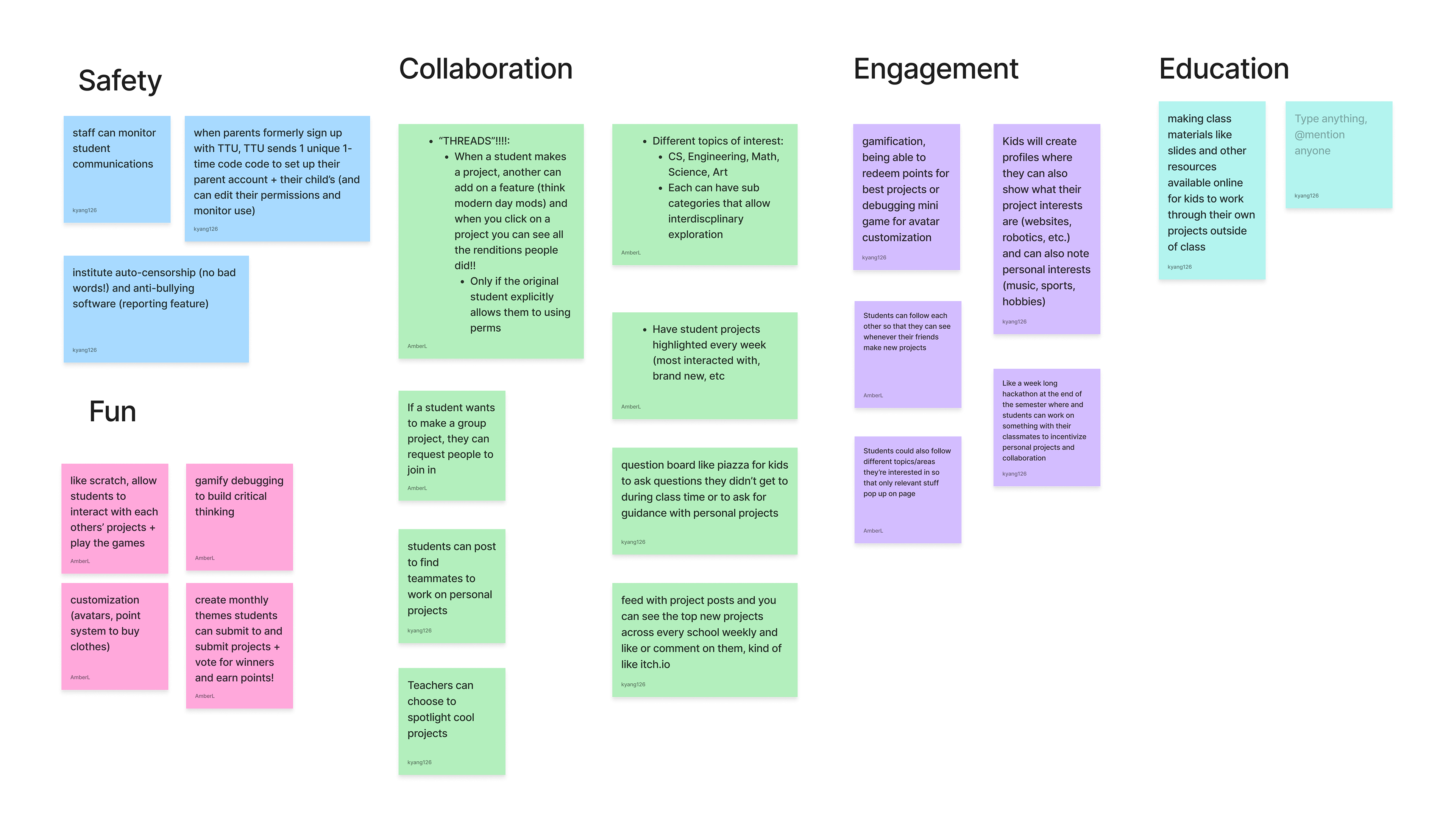
Research highlights
Safety
Online platforms can bring about concerns regarding unverified identities, inappropriate interactions, and inappropriate content.
Learning gap
When a program ends, learning momentum stops. There is no structured way to continue online.
Active participation
Most online platforms encourage passive consumption. TTU wants students to see themselves as creators within a collaborative community.
SOLUTION OVERVIEW
Creative Base Station extends Tech Turn Up’s classroom community into a supervised space for students to create, collaborate, and continue learning.
CBS was designed as a shared platform for students, teachers, parents, and administrators, with different capabilities based on each user’s responsibilities. CBS ultimately combines the social aspects of the in-person community with the structure and supervision needed for an educational environment.
Account creation
Teachers and staff emphasized the importance of verifying student identities and limiting access to known users. We therefore designed account creation around staff verification, with teachers and staff creating student accounts using school email addresses and staff-generated passwords.
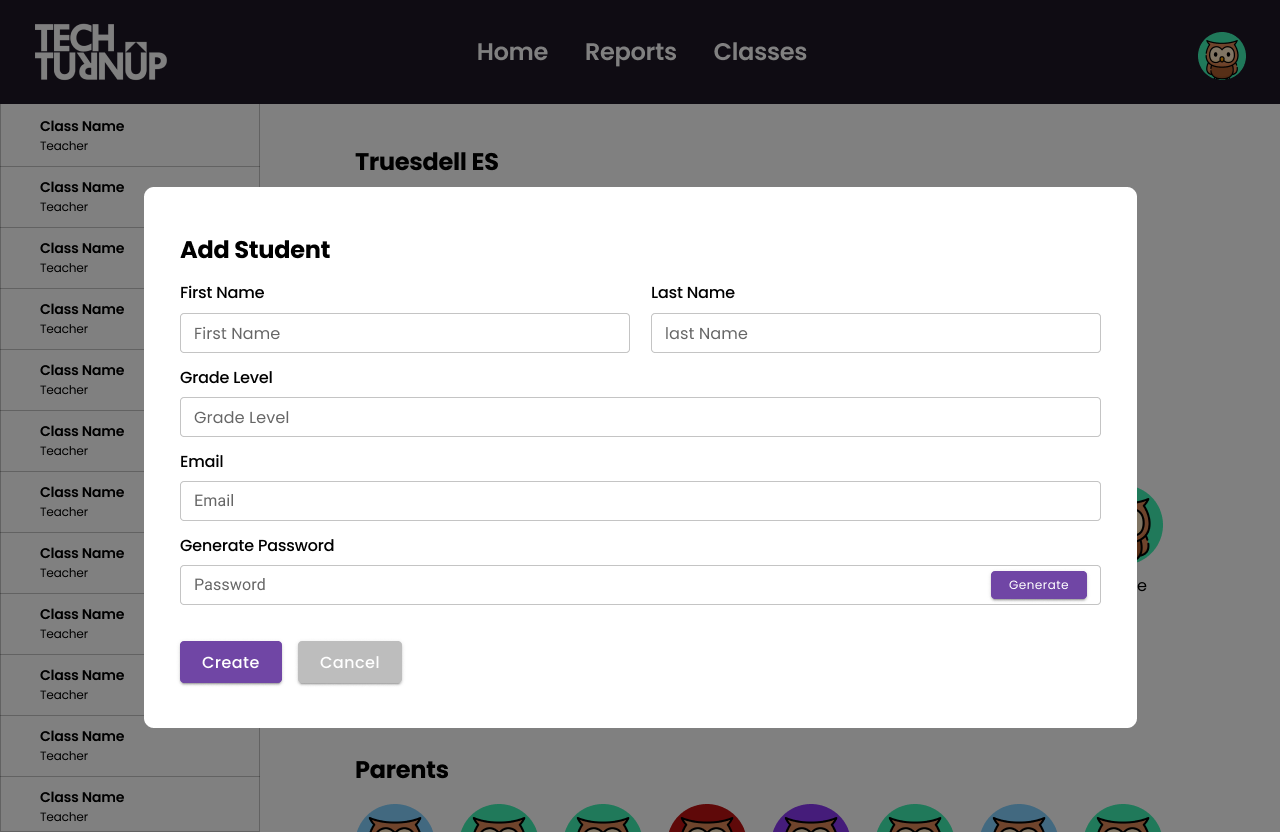
Add student feature, which is only available for students or admin
Project creation, collaboration, and reflection
Teachers emphasized the philosophy, “build something, not just learn about it.” Thus, we made project creation one of the central experiences of CBS. Students upload their projects, describe their process, share their work, comment on other projects, and tag collaborators. We also incorporated reflection directly into the project workflow as it is something that is encouraged in the in-person curriculum.
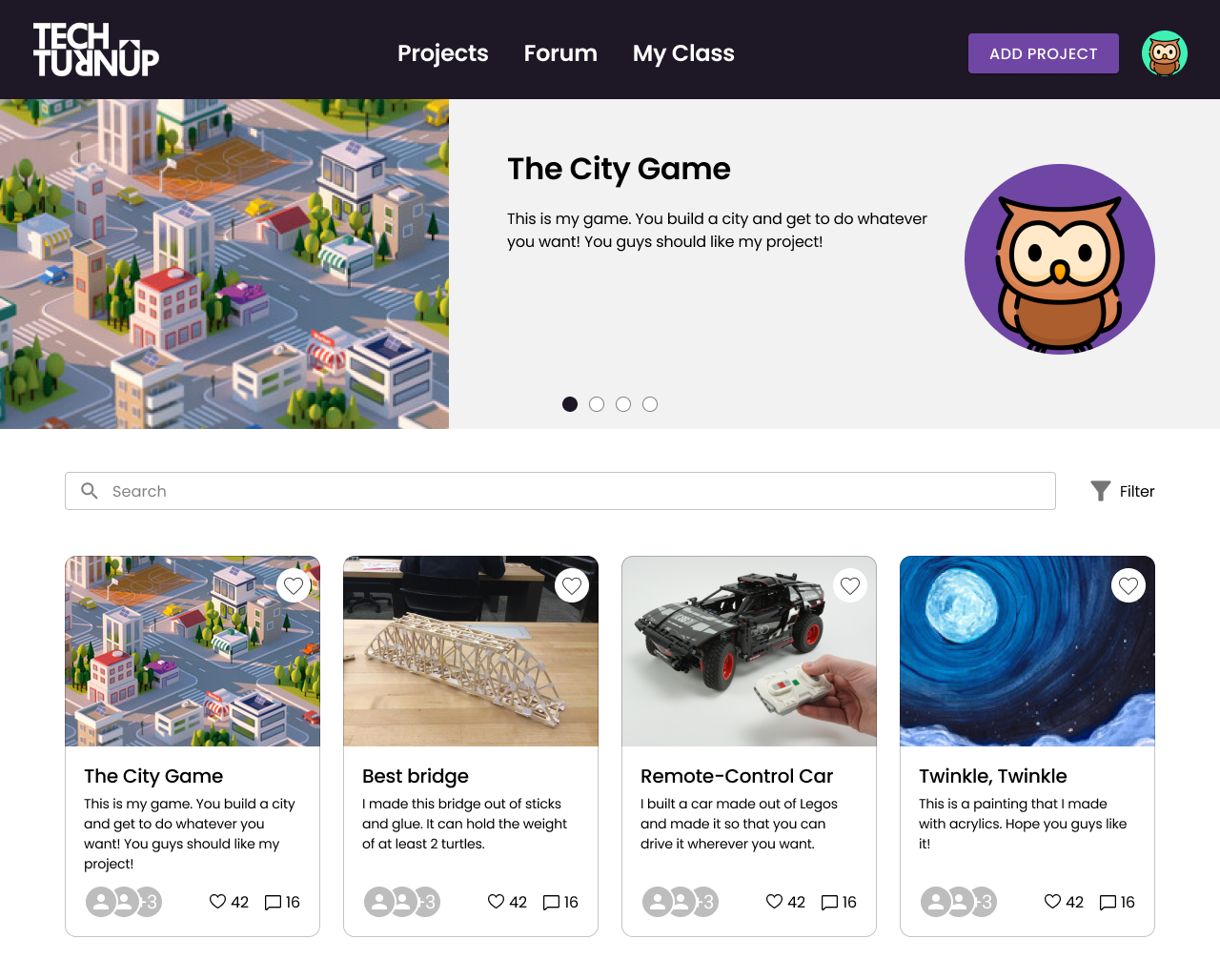
Student home page that shows featured projects
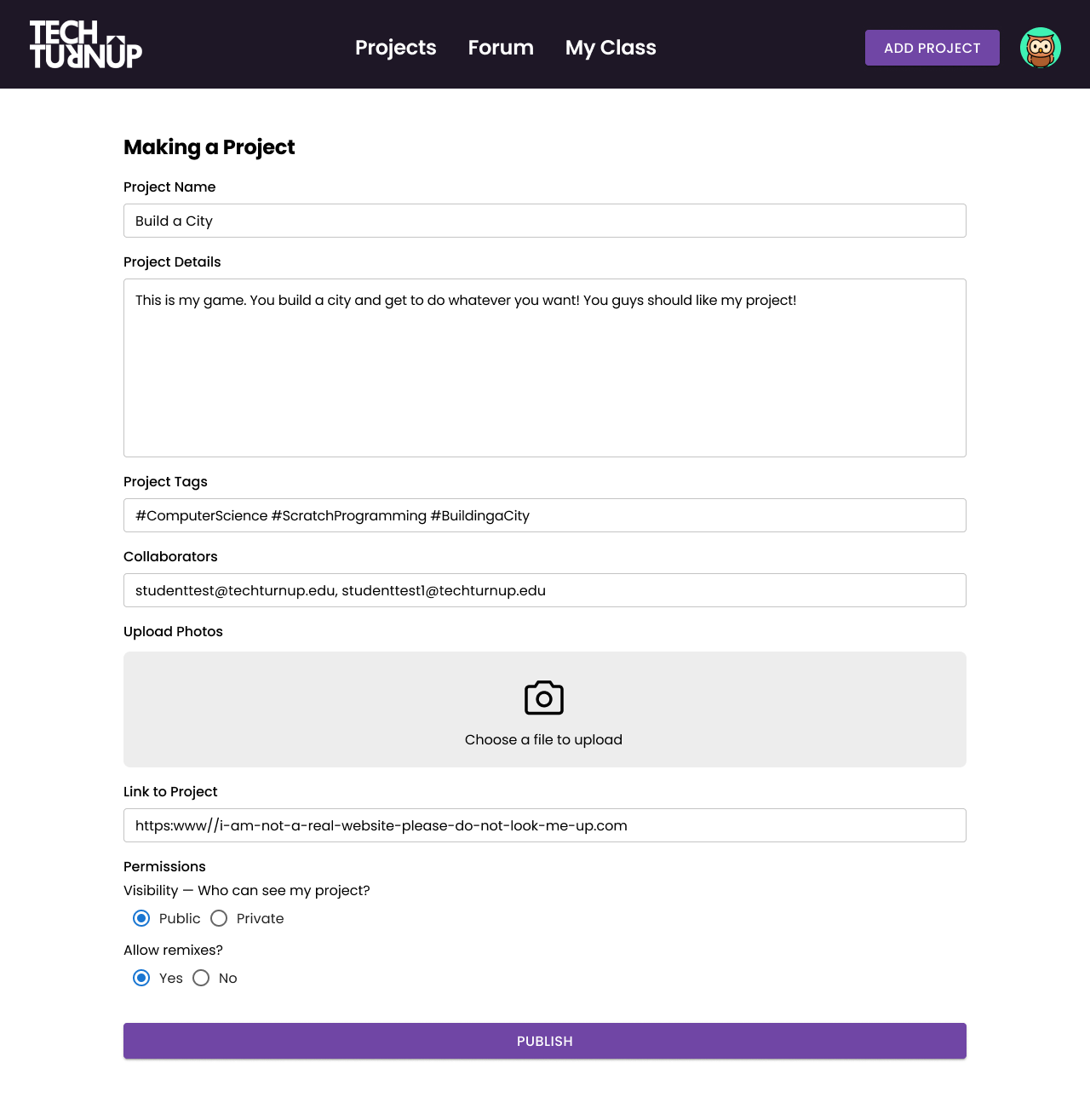
Uploading a project to the platform
Project “remix”
Students can build upon one another’s ideas through Remix. Instead of simply liking or viewing another student’s project, students can create their own iteration based on existing projects and see how their work may have inspired their peers.
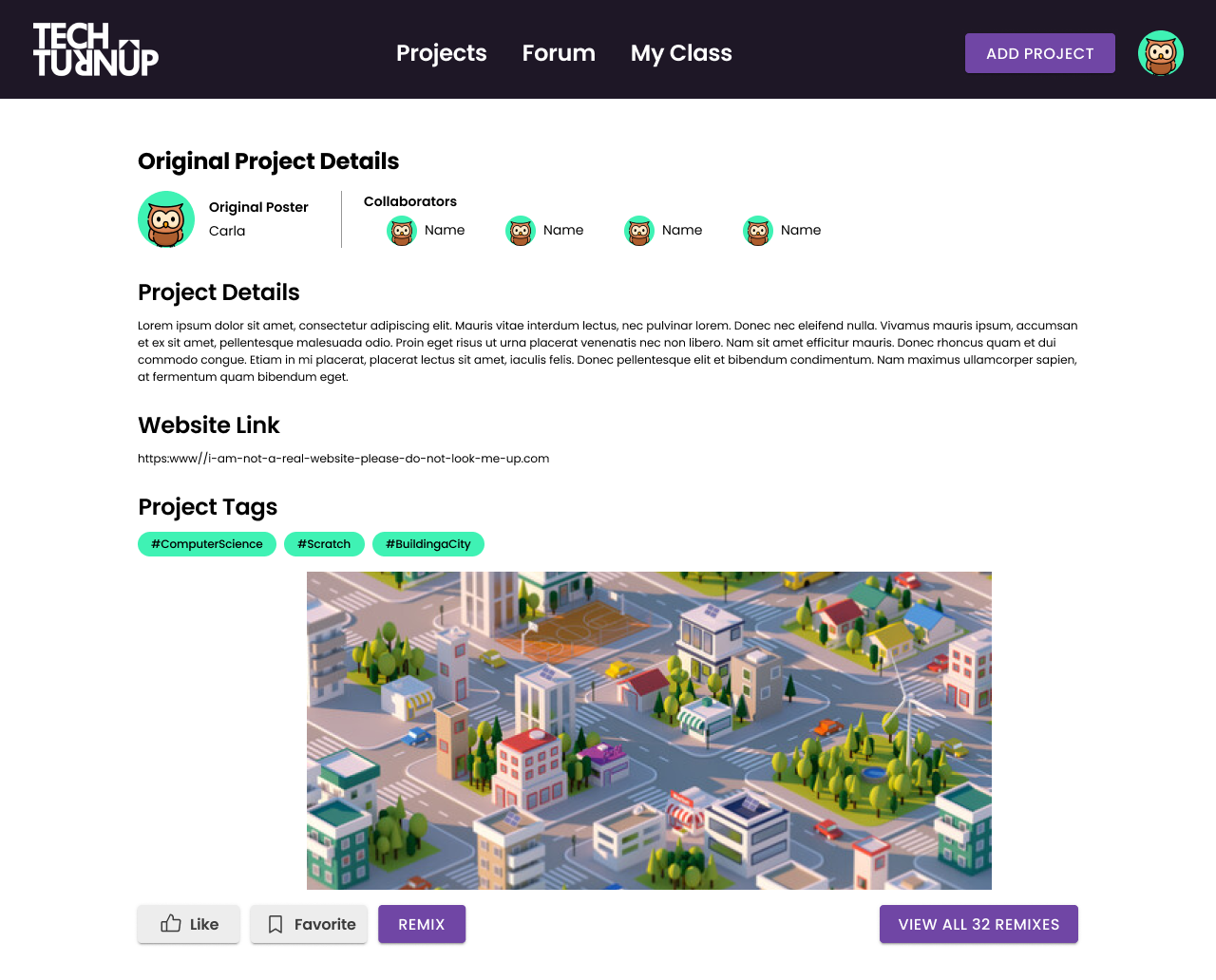
Preview of the original project while filling out the remix question fields
Monthly design quests
Students expressed wanting variation in their projects as well as additional motivation to participate. Teachers can therefore create monthly design quests with custom themes under a hashtag. Popular projects will also be spotlighted on the main page, providing more incentive for students.
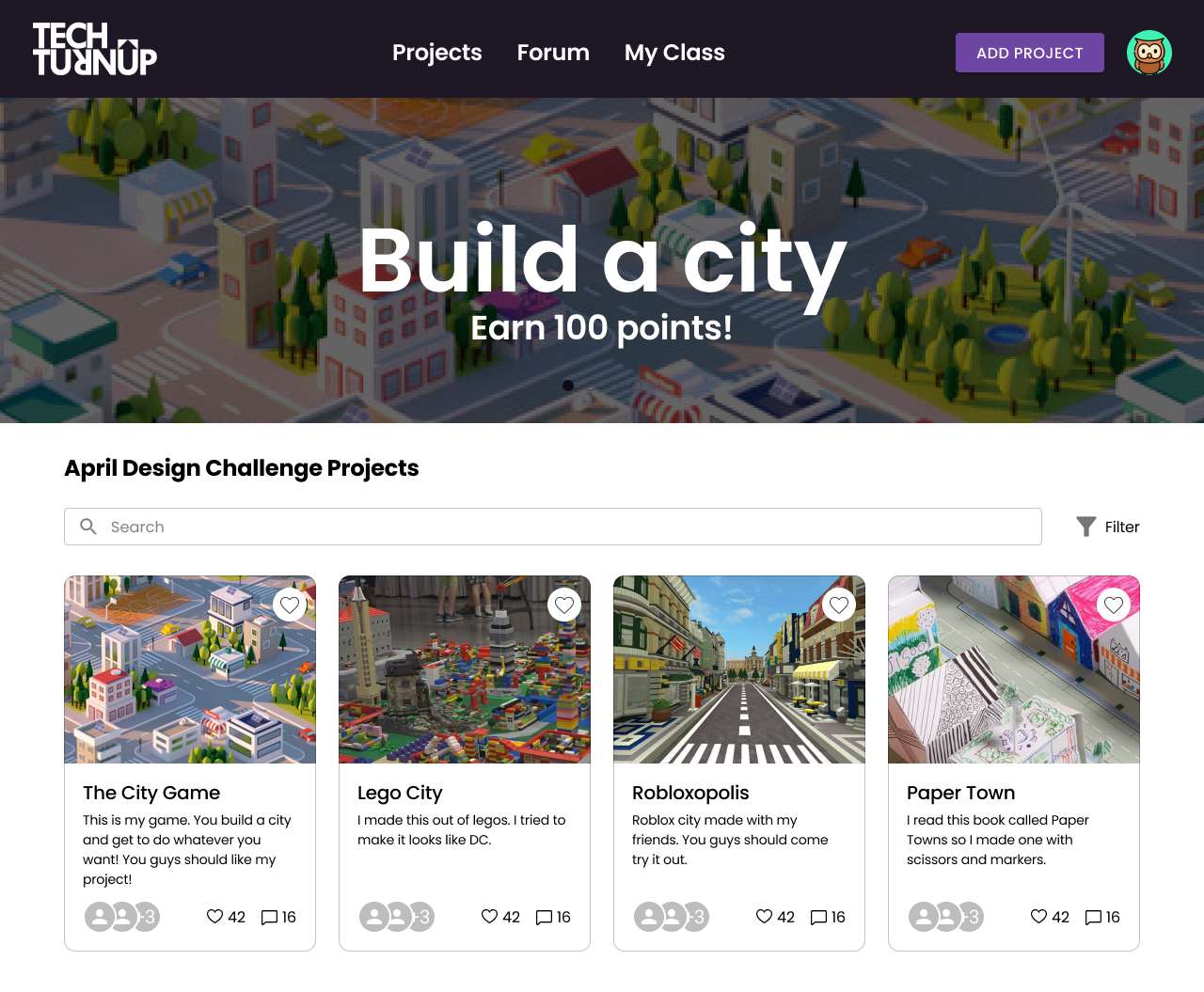
Monthly design quest header and posted projects
Class forum
Students told us they sometimes needed additional support when they were confused about a topic or project. The class forum provides a place for students to ask questions and receive responses from teachers or classmates. Rather than positioning teachers as the only source of knowledge, the forum encourages students to learn from one another.
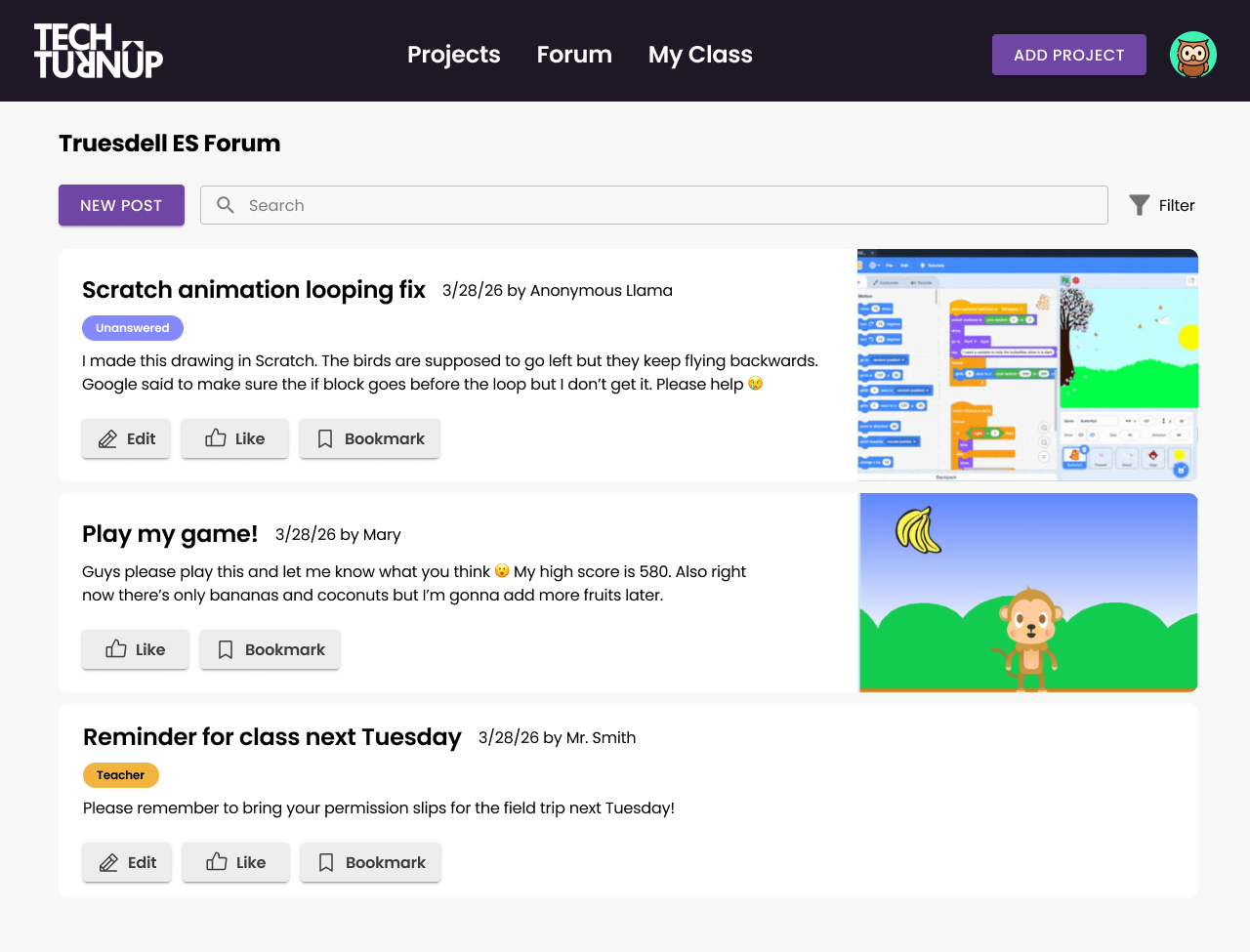
Class forum home page
Achievements, leaderboard, and avatar customization
Staff were concerned about passive consumption rather than active participation. We introduced a points and achievement system to reward students for their contributions. They can earn points by completing teacher-created challenges, reaching project checkpoints, answering classmates’ questions, remixing projects, and attending class. Points can spend their earned points by customizing Tina Turn-Up, the platform’s mascot. Ultimately, we design this to make positive participation visible and
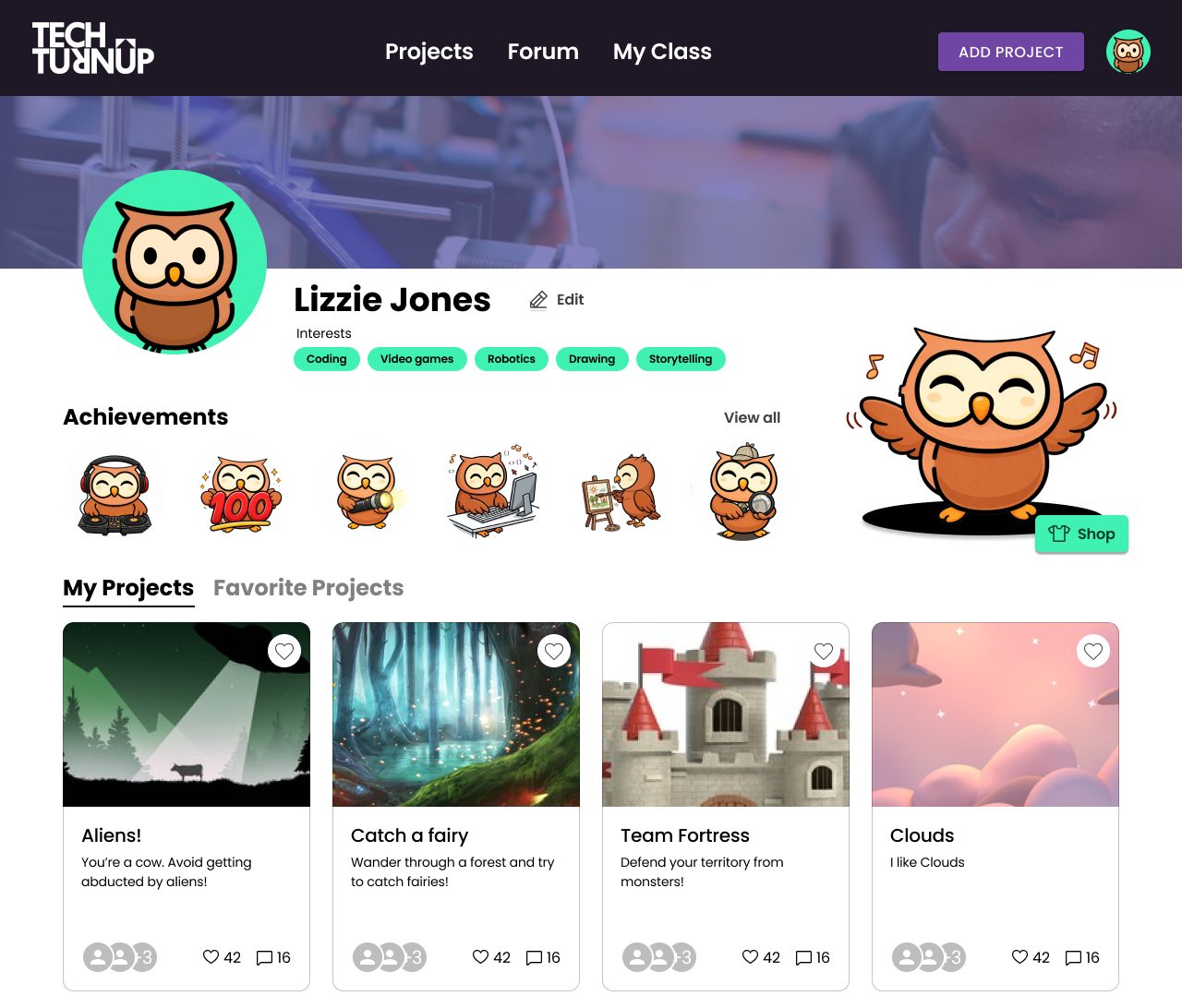
Student profile, showcasing achievement badges and their personalized character
Content reporting and activity monitoring
Because students would be sharing their work, we were concerned about bullying, inappropriate content, and plagiarism. Students and parents can report concerns about projects or interactions directly to teachers. Teachers and authorized staff can monitor all project posts and comments; parents have visibility into their child’s activity. This creates a balance between student independence and adult supervision as well as supports TTU’s primary concern of safety.
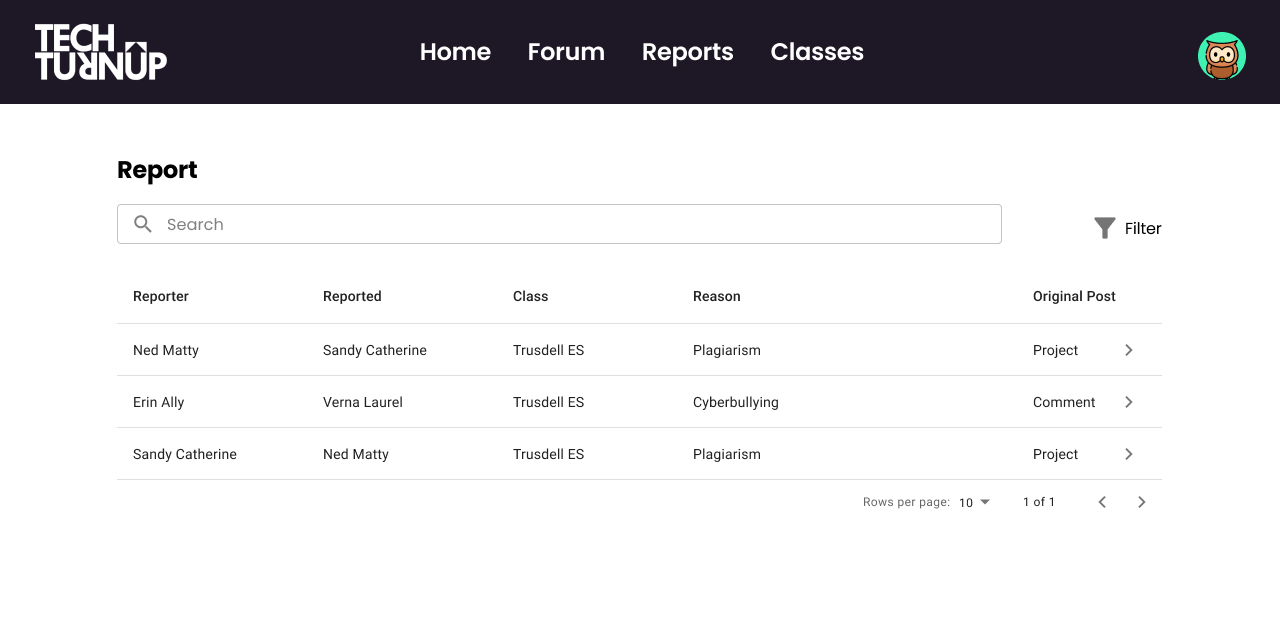
Teacher and admin view of student-made reports
KEY DESIGN DECISIONS
With only 48 hours to design, we had to continually evaluate whether each idea supported our core values.
Replacing remix threads with an overview
Our initial idea for Remix included Threads: a timeline showing how remixed projects evolved as different students remixed it. While the concept made the creative process visible, we realized that a timeline may lead to too much passive consumption. This conflicted with one of our core findings in that TTU wanted students to be active creators. We instead opted for the “Remix Overview,” with a simple grid UI.
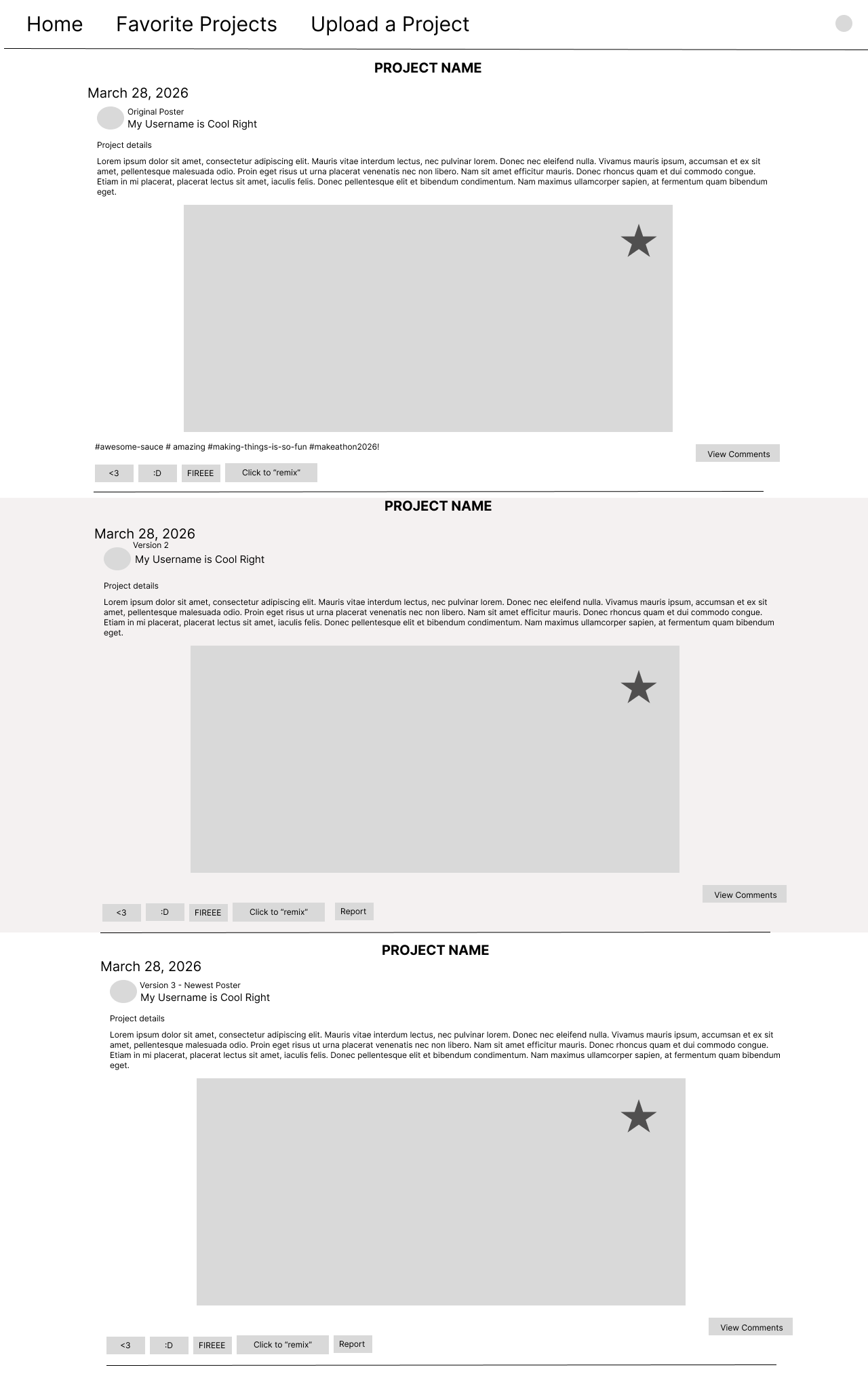
Mid-fidelity prototype of Threads
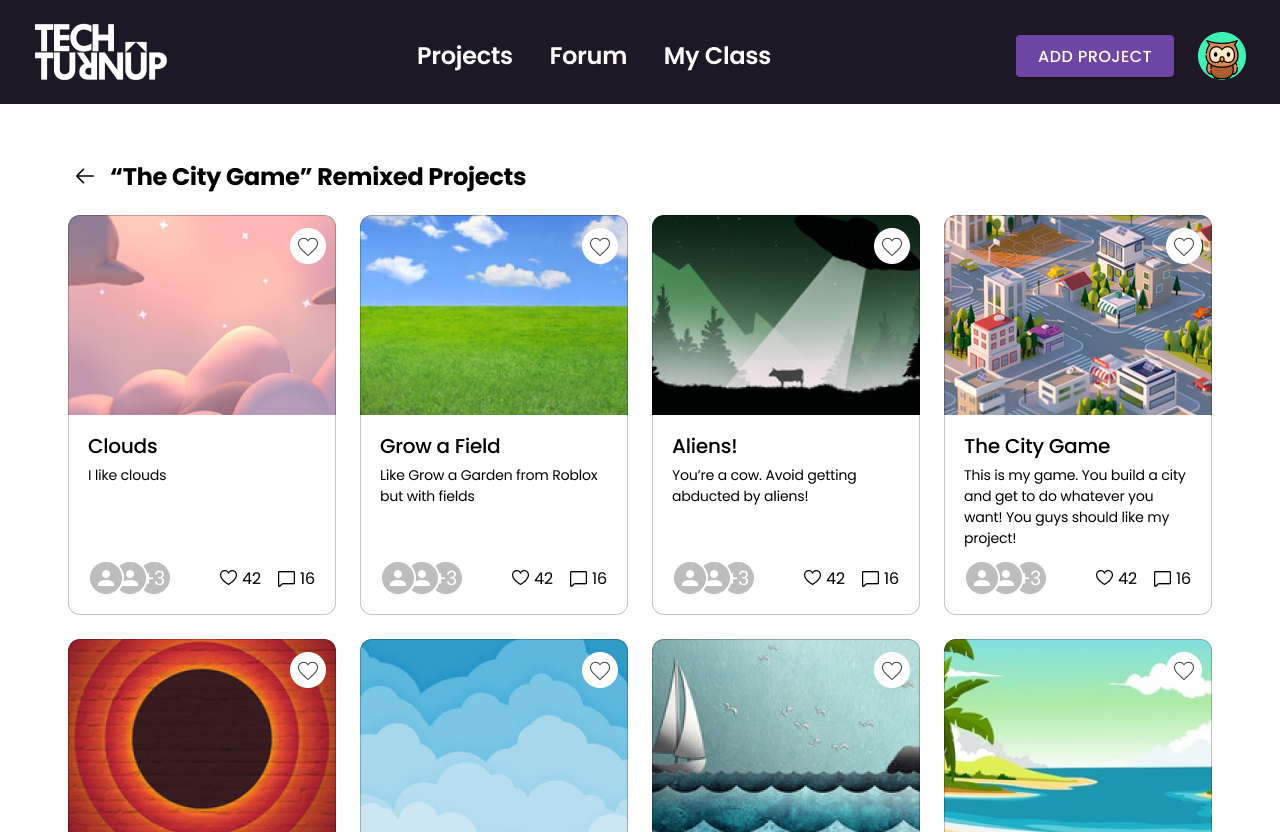
High-fidelity prototype of Remix Overview
Removing the global feed
We initially explored a global feed where students could discover projects from other TTU locations, potentially expanding across different sites or even states if the platform were to scale. However, we inevitably abandoned this idea as it would be a greater burden for teachers to ensure safety, and it strays away from the “small group feel” that helps build a sense of community.
REFLECTION AND CONCLUSION
Designing within a make-a-thon timeline taught me how to make decisions quickly without losing sight of the people we were designing for.
Stakeholder interviews changing product directions
Having the opportunity to speak directly with TTU stakeholders on the first day significantly influenced our design. Concerns around safety, participation, and learning continuity eventually became the criteria we used when designing.
Prioritizing features
The compressed timeline meant that we could not explore every possible solution. Because we had to balance research, ideation, wireframing, prototyping, and presentation within a short window, our team had to constantly decide what was worth designing and what could be left for later. Keeping in mind our core values and the concerns we decided to address helped us stay focused on our product.
Future goals
If we had more time, I would have liked to test our product with the intended user types to identify usability issues and validate whether the platform actually encourages the behaviors we designed for. In regard to accessibility, I would continue developing a mobile experience, especially because some students mentioned not having access to a computer. I would also revisit the local versus global community question by exploring a permission-based system that could allow students to interact with peers from other sites while maintaining the small community structure.